


The Digital Assets Association (DAA) which is dedicated to fostering responsible development and adoption of institutional digital assets, has announced its official launch. By bringing together financial institutions, fintechs, technology providers, and legal and regulatory experts, the DAA aims to bridge the gap between traditional finance and the transformative potential of tokenized real-world assets (RWA). The launch of DAA represents a key step forward in the financial industry to facilitate greater collaboration between industry players and key stakeholders. The DAA committee is made up of a passionate group of industry leaders who believe in the future of digital assets, from early-stage innovative companies to notable financial players and service providers.
The inception of DAA was spearheaded by the leaders of DigiFT, a regulated on-chain exchange for RWA, which actively fosters the growth of an ecosystem for digital assets while providing unwavering support for industry development; Onfet, a blockchain-based technology company aimed at enhancing operational efficiencies; and Tranchess, a tokenized asset management and derivatives tracking protocol. Together, the organizations aim to drive the growth of a digital assets ecosystem and support industry development.
A collaborative ecosystem for the future of finance
Recognizing the immense potential of asset tokenization to unlock liquidity, streamline transactions and democratize access to previously illiquid assets, the DAA will provide a platform for stakeholders to come together and navigate the landscape with shared expertise to:
- Share knowledge and best practices: Through working groups, conferences, and online resources, the DAA will facilitate knowledge exchange on diverse topics such as regulatory frameworks, technological advancements, and market insights.
- Develop industry standards: The DAA will work with its members to establish common ground on critical issues such as tokenization protocols, risk management frameworks, and data governance.
- Advocate for responsible adoption: The DAA will engage with policymakers and regulators to promote responsible legal and regulatory frameworks that foster innovation while mitigating risks.
- Empower tomorrow’s leaders: The DAA’s Talent Development Initiative aims to bridge the skills gap, nurturing a diverse, future-proof workforce through training, mentorship, and industry placements.
Financial institutions, fintechs, technology providers, and legal and regulatory experts, who are keen to contribute to shaping the future of digital assets can apply for membership through DAA’s website (https://digitalassetsassociation.org/).
Mr Henry Zhang, Founder & CEO of DigiFT, said: “As the first regulated exchange for on-chain real-world assets, approved as a Recognized Market Operator with a Capital Markets Services license by the Monetary Authority of Singapore, we recognize the industry’s need in charting a trusted path towards on-chain assets. The launch of DAA is meant to be that platform that empowers the financial services ecosystem to unlock the full potential of tokenization.”
Mr Chia Hock Lai, CEO of Onfet, said “Institutional digital assets including RWA tokenization are an important component of the future of finance. The Digital Assets Association can unify the market, promoting responsible practices and building efficient, institutional-grade digital assets for all. ”
Mr Danny Cheong, CEO of Tranchess, said: “In the dynamic landscape of digital assets, our association stands as a beacon for progress. We’re dedicated to advancing the industry through education, collaborative efforts, and the responsible tokenization of real-world assets, ensuring a sustainable and inclusive future.”
Mr Daniel Lee, Head of Web3 at Banking Circle, said: “RWA will act as a bridge for traditional finance to decentralised finance, however, there would be many regulatory and technological challenges. I hope that DAA will be able to facilitate discussions and engagement with regulators to resolve these issues”
Ms Chang Tze Ching, CEO of Bright Point International Digital Assets, said: “At BPI, we are committed to staying at the forefront of technological innovation and view the adoption of blockchain and digital assets as the next step to our mission of delivering value to our clients. “
UK proposals for stablecoins should incentivise DLT-based capital markets
The Association for Financial Markets in Europe (AFME) has issued a statement in response to the UK Financial Conduct Authority and Bank of England consultations regarding the regulatory framework for stablecoins.
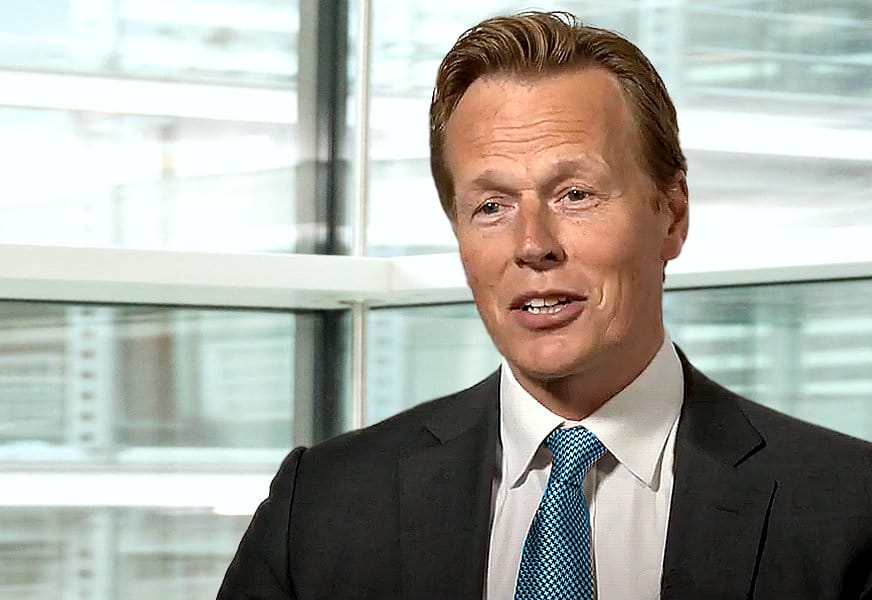
James Kemp, Managing Director of Technology and Operations at the Association for Financial Markets in Europe (AFME), said: “The UK’s plan to bring stablecoins into the regulatory perimeter is a positive step towards creating a safe and sound system for cryptoassets, and towards promoting confidence in DLT-based capital markets. However, AFME has concerns around the proposed design of a number of the rules, which in their current form will have negative consequences for wholesale markets and participants.”
Specifically, AFME suggests:
- The territorial scope of regulated custody activities should not deviate from current market practice. We disagree with the proposed expanded territorial scope to capture relevant cryptoasset activities undertaken from outside of the UK. This proposed treatment would represent a significant departure from the way the territorial scope for regulated financial services activities (including the custody of security tokens) is currently determined under the UK framework.
- Cryptoassets qualifying as specified investments (including security tokens) should be treated as such throughout the regulatory framework and not be subject to a proposed separate regime for custody. The FCA’s approach to regulating the custody of cryptoassets should distinguish between the custody of cryptoassets qualifying as specified investments (including security tokens) and the custody of other cryptoassets (including stablecoins). Existing FCA rules should be maintained for the custody of cryptoassets that meet the definition of specified investments (including security tokens) and tokenised deposits.
- To facilitate and incentivise the issuance of regulated stablecoins, the criteria for FCA-regulated and BoE-regulated stablecoins should not be overly restrictive. We view that the criteria for backing assets should be broadened beyond short-term government bonds and cash-deposits for FCA-regulated stablecoins and central bank deposits for BoE-regulated systemic stablecoins and should at a at a minimum include high-quality liquid assets.
- It is imperative that wholesale financial institutions should be able to easily access and use overseas issued stablecoins (e.g. USDC). We believe that the FCA should reconsider the proposed requirement for a UK payment arranger in relation to wholesale payment chains or at a minimum delay its implementation until international frameworks and markets mature.
2023: Digital Asset fund flows annual report
Acording to CoinShares research, Digital Asset investment products saw US$2.25bn of inflows for the full year in 2023, marking it as the 3rd largest year based on data back to 2017, surpassed by 2020 at US$6.6bn and 2021 at US$10.7bn. Importantly the inflows were 2.7x the inflows seen in 2022, marking a dramatic turnaround for the asset class. Much of the recovery was in the final quarter where it became increasingly clear that the SEC was warming up to the launch of Bitcoin spot-based ETFs in the United States. Total assets under management (AuM) has risen by 129% over the year, ending at US$51bn, the highest since March 2022.
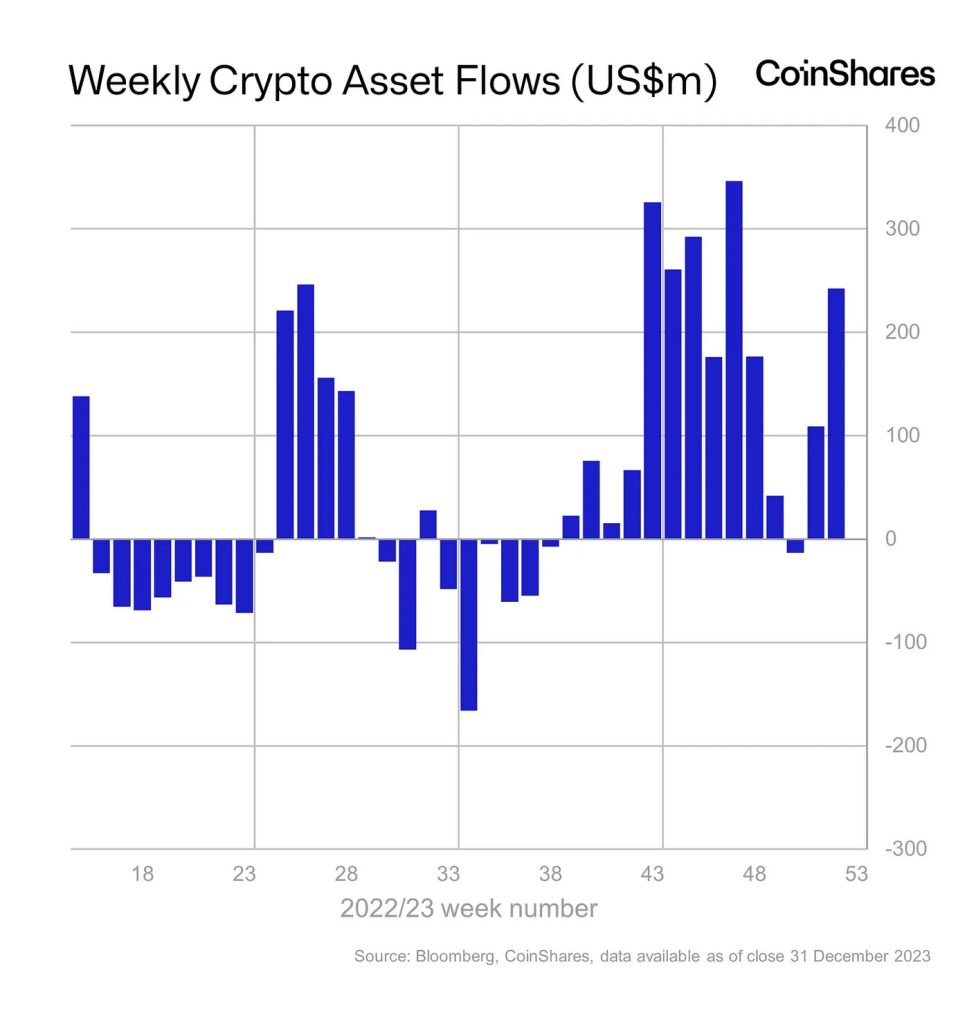
Bitcoin was by a wide margin the greatest benefactor from improving investor sentiment, with US$1.9bn of inflows, representing 87% of total flows. Its dominance in flows is the largest in history with the prior peak being 2020 where it received 80% of the flows and the lowest being 2017 at just 42%. There does not seem to be a discernible trend here, with the most likely cause being hype around and SEC ETF approval.