


Zumo releases Digital Asset and blockchain report
B2B Digital Assets infrastructure Zumo has released a report that identifies the opportunities across the Digital Asset and blockchain ecosystem. The report, entitled ‘Digital Assets 2023: Identifying the opportunities,’ comprehensively surveys and analyses the emerging areas of opportunity within the global Digital Asset ecosystem from an enterprise perspective. Targeted at companies, organisations and financial institutions with an interest in the practical application of Digital Assets in their own business, it provides a filtered overview of the Digital Asset landscape based on expert contributions from some of the industry’s largest enterprises, solutions providers, and independent analysis.
At a glance:
It traces the evolution of blockchain from an enterprise perspective, identifying four turning points characteristic of a progressive broadening in Digital Asset applications and participants.
It then uses this to construct an enterprise ecosystem map distinguishing consumer-facing and institutional-facing solutions, and investment versus applied use cases.
It concludes that 4.0 is the first truly ‘enterprise era’, in which enterprise has access to, and is active across, all four quadrants of Digital Asset opportunity.
It continues on to assess the opportunities, challenges and inter-relationships associated with nine individual use cases, which the report authors categorise according to their framework as early (institutional Digital Asset investment; institutional DeFi; web3); developing (tokenisation; blockchain in industry; DLT for financial market infrastructure) and established (consumer facing cryptoasset investment; and individual/business blockchain payments).
To download the report please visit: https://zumo.tech/digital-assets-2023/
Trends in Regulation of Digital Assets
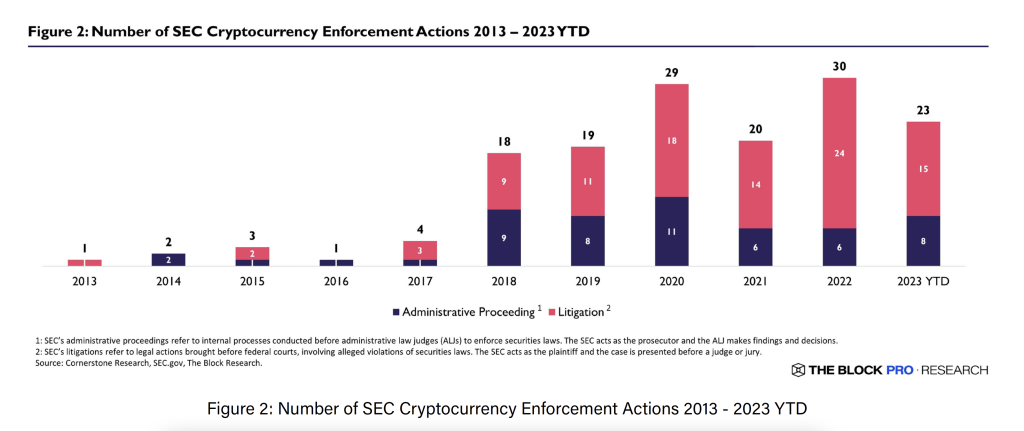
The Block Research’s Trends in Regulation of Digital Assets report provides an extensive analysis of the regulatory landscape and enforcement actions surrounding cryptocurrencies in the United States and various international jurisdictions. The aim is to understand the complexity of regulations, asset classification, and the impact on crypto-related businesses and third parties. The report is structured into four main sections:
Part 1: Introduction
The report begins with an introduction outlining the importance of understanding the regulatory environment for cryptocurrencies.
Part 2: United States – State of Regulation and Enforcement Actions
This section delves into the regulatory complexities in the United States, covering the current regulatory focuses, including enforcement direction, asset classification uncertainties, and the differing approaches of regulatory bodies. The report also examines the impact of regulation by enforcement, recent banking uncertainty faced by crypto firms, and the repercussions of these developments on crypto-associated third parties.
Part 3: International Jurisdictions – Crypto Regulation Landscape
This section explores the regulatory landscape in several international jurisdictions, covering noteworthy trends in the Middle East, European Union, United Kingdom, Asia and Latin America. Global regulators have responded to significant crypto-related incidents in 2022 by actively developing and updating regulatory frameworks for crypto-assets. The report also recognizes the need for further development in addressing crypto-native concepts like DeFi regulations.
Part 4: Conclusions and Outlook:
The report concludes by summarizing the key findings and highlighting three potential industry developments: a focus on safer assets, a reduction in U.S. exposure, and the segregation of
activities.
To download the report please visit: https://www.theblock.co/post/241807/trends-in-regulation-of-digital-assets-presented-by-fti-consulting
Digital Assets: Managers Fuel Data Infrastructure Needs
Between May and June 2023, Coalition Greenwich conducted research, in partnership with Amberdata, to better understand how institutions are implementing Digital Assets, including investment strategies, products, data, and technologies to support the asset class. The firm conducted online interviews with 60 buy-side professionals from asset managers, hedge funds and other investors in the United States and the United Kingdom/European Union.
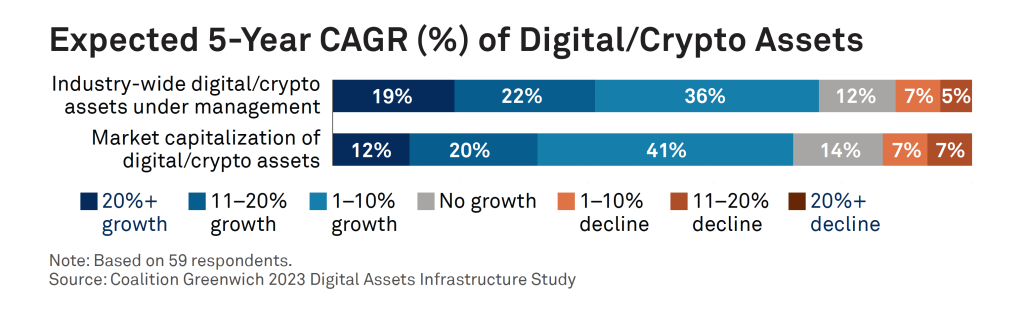
Their roles include portfolio managers, traders, analysts, researchers, and managing directors. Almost half (48%) of these buy-side respondents have Digital Assets under management (AUM), reflecting a mix of active investors and those with some curiosity. In addition, the firm conducted extensive qualitative interviews with several sell-side institutions and infrastructure players active in the market, to round out the findings on use cases, pilots and infrastructure used to support Digital Asset trading and investing. The Digital Asset market is anticipated to grow at a healthy clip, according to their research, with three-fourths of managers expecting Digital Asset AUM to grow over the next five years, and over 40% expecting very strong growth (11–20%+ growth). Moreover, managers see an opportunity to expand their AUM faster than the overall market with 44% expecting Digital Assets to be a growing business line over the next three to five years. Thus, while Digital Assets may not be for every type of manager at present, a growing set of firms expect to manage these assets.
To view the full report please visit: https://www.greenwich.com/market-structure-technology/digital-assets-managers-fuel-data-infrastructure-needs
A shared commitment to shaping the Digital Asset era
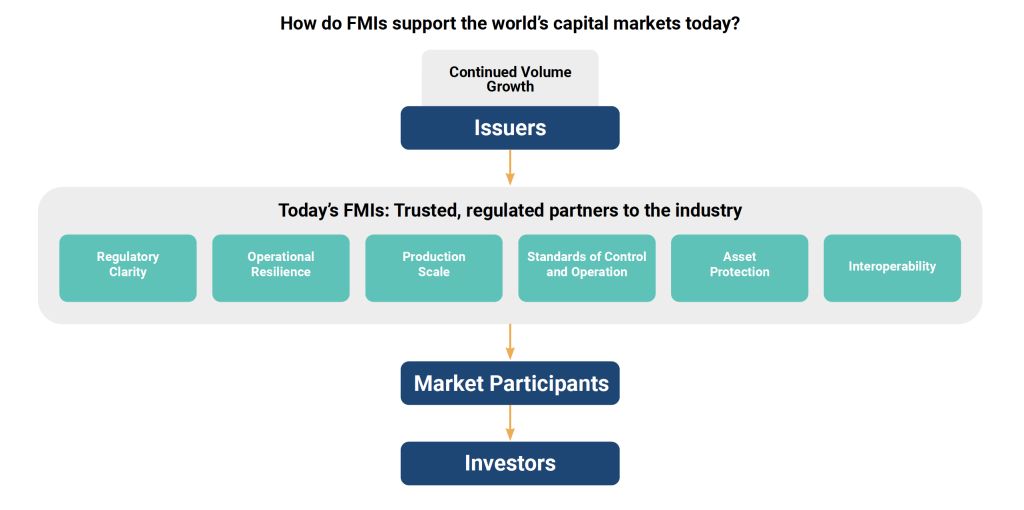
DTCC, Clearstream, and Euroclear have released a new white paper to the industry – Advancing the Digital Asset Era, Together, which calls for increased collaboration to progress an ecosystem that currently includes fragmented standards, varying regulatory treatments, limited integrations with institutional-grade payment rails and siloed liquidity – all limiting factors to the further digitalization of global financial markets. The firms believe that DLT and Digital Assets are beginning to deliver transformational benefits to market participants at every step of the trade lifecycle. Given current momentum and levels of adoption, they also believe that DLT is here for the long term. Yet, they say, as an industry we face a challenge in realising these benefits at a large scale. The individual and private explorations of DLT’s potential now need to become an industry-wide effort to consolidate and connect digital liquidity, based on common standards and processes. As FMIs, DTCC, Clearstream and Euroclear say they are committed to being at the forefront of this discussion. They are neutral, trusted and resilient partners to the industry, and have a unique role to play in unlocking the value of Digital Assets for the benefit of the markets and underlying investors.
Working with partners and participants, they say their organisations will continue to collaborate to support market development by:
- Driving open, market feedback around the required characteristics of DLT networks, data access, privacy and smart contracts
- Enabling greater interoperability across DLT protocols through the adoption of standards
- Enhancing operational resilience
- Accelerating production scale
The whitepaper can be read here: https://www.dtcc.com/dtcc-connection/articles/2023/september/18/fmis-role-in-advancing-the-digital-asset-era
Source: DTCC / Clearstream / Euroclear