

Pyxtrial’s architecture
Pyxtrial’s architecture has three elements: data model, database and APIs.
The data model is Pyxtrial’s foundation, defining how data are structured, with the database reflecting data on liabilities and assets that have been retrieved from on-chain (public) and off-chain (non-public) sources, and then storing and processing those data. Pyxtrial makes the most recent data available to its users – the stablecoin issuer’s regulator or supervisor – via a dashboard. The testing of Pyxtrial showed it has the capability to support the monitoring of asset-backed stablecoins’ balance sheets, with five such stablecoins covered in the proof of concept (PoC) tool.
The use of APIs as a mechanism for data transmission allows Pyxtrial to monitor stablecoin issuers’ assets and liabilities without the need to directly connect to the blockchain network. Consequently, Pyxtrial could be adapted to also obtain data from permissioned private chains; however, this capability has not yet been tested.
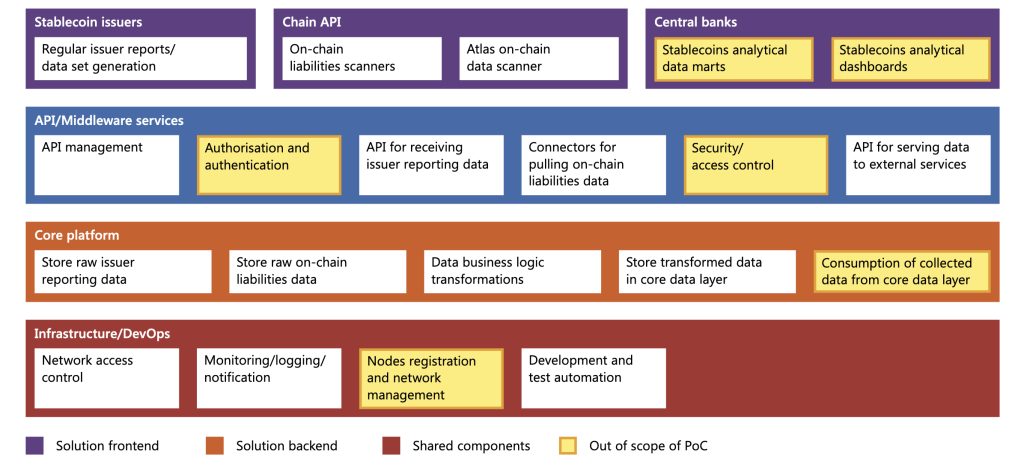
Pyxtrial’s functional architecture
It is important to note that Pyxtrial does not assess asset quality, the rigour of asset valuations or the quality of the data sources used. Hence there would be a key dependency on the rigour of valuations and the quality of data provided to Pyxtrial, and supervisors may need to play a role in setting out rules or guidance on data quality. Additionally, multiple valuations may exist for a particular asset, for example from different data providers. Functionality for asset valuation would need to be added to Pyxtrial and, should it rely on external data providers, would require them to be connected to the Pyxtrial database by some means, most likely via an API.
Pyxtrial’s key findings are:
Pyxtrial provides a PoC monitoring tool that could support supervision of issuers of the selected digital assets. By collecting and processing both on-chain and off-chain data, Pyxtrial would enable the monitoring of digital asset balance sheets, thereby supporting the supervision of stablecoins.
Regulators must have the requisite in-house skills. The operation and implementation of Pyxtrial will require a multidisciplinary team. Regulators will need to ensure that their supervisors possess the required skills for sourcing on-chain data.
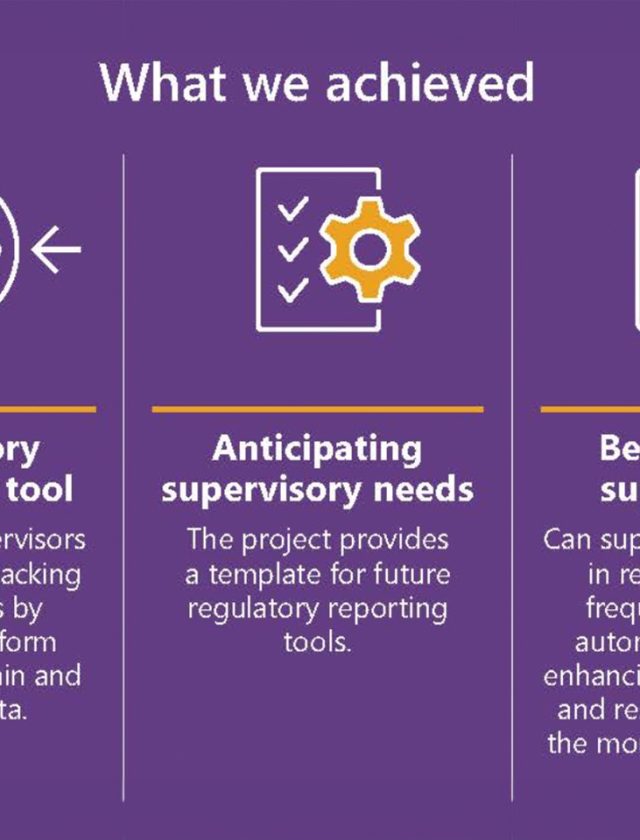
Further work is required before Pyxtrial can be rolled out. Pyxtrial is a reporting and monitoring platform. It anticipates supervisory needs by providing a template for future regulatory reporting tools that will be needed to monitor stablecoins. It is a PoC and not a ready-made product.
If Pyxtrial were to be implemented, it would facilitate risk monitoring. Pyxtrial enables earlier identification of potential risks as supervisors have access to timelier stablecoin data in a standardised format. Additionally, Pyxtrial could bring value to cross-border supervisory cooperation as it enables host regulators to assess the backing of an overseas-issued stablecoin.
Flexibility is a fundamental feature (and requirement). Pyxtrial was designed to be adaptable. Its technical components (the APIs, data model, data storage solution and dashboard) are modular so regulators and central banks can switch them out or build upon them. In this way, regulators can integrate Pyxtrial into existing systems, enhance it and adapt it to their current and future needs. Additionally, supervisors have the ability to adjust Pyxtrial to account for a higher frequency of attestation reporting in order to meet regulatory needs for more frequent reporting by stablecoin issuers, or to implement APIs, allowing them to pull data from firms’ systems when needed.